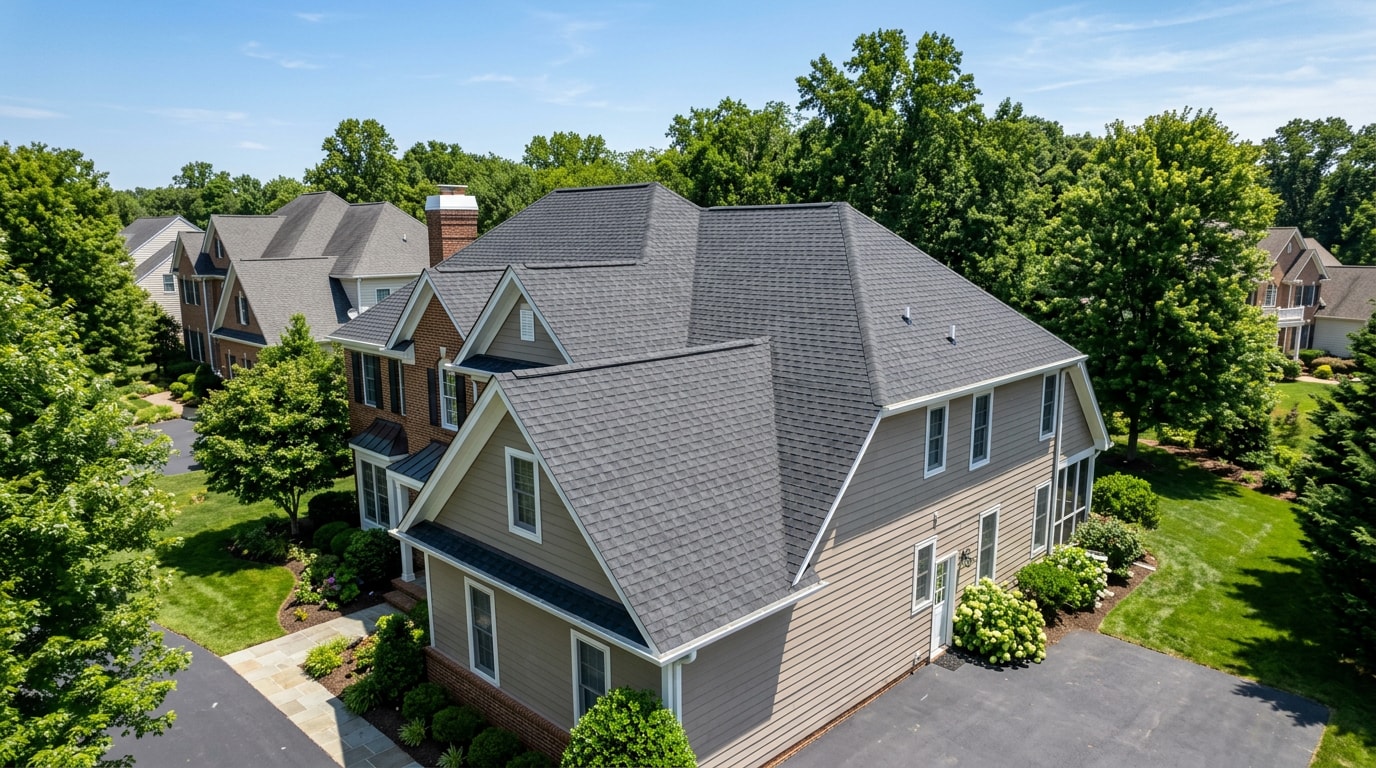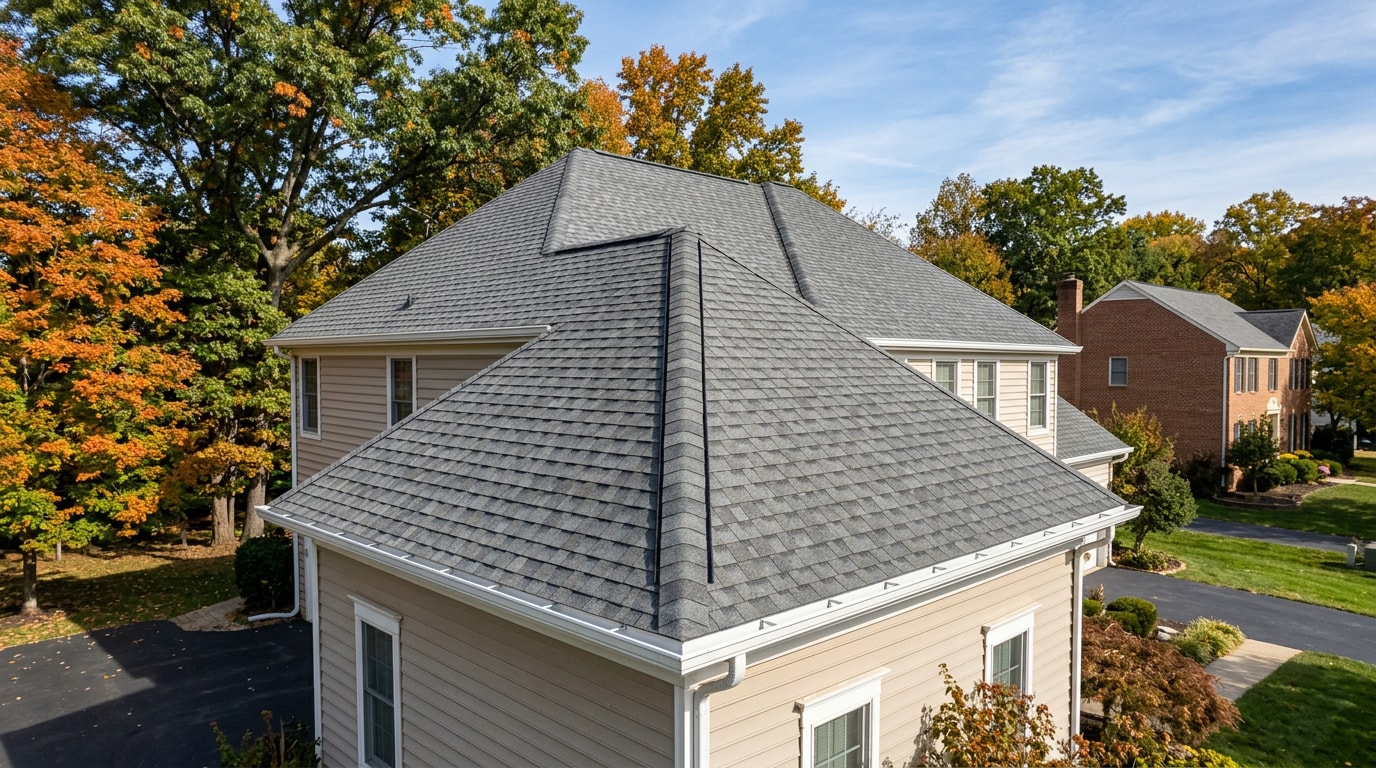
Roofing ventilation and energy efficiency in Reston, VA are tied together by something most homeowners never see: the air moving through their attic. A roof that traps heat and moisture forces the HVAC system to work harder all year, even in a home with newer insulation. This guide breaks down the mechanics, the warning signs, and the fixes that actually move the needle on your energy bill.
How Roof Ventilation Mechanics Drive Energy Efficiency
Warm air rises. In a properly vented attic, cooler air enters low through soffit vents while hot, humid air exits high through a ridge or gable vent. That constant exchange is what keeps the space under your roof deck from turning into a heat trap.
In the summer, natural air flow in a well-vented attic moves super-heated air out of the attic, protecting roof shingles and removing moisture. The system depends on balance, not just vent count. Add exhaust without enough intake and the airflow reverses on itself.
Attic fans pull in cooler outside air through soffit and gable vents and push hot air out, but if soffit vents are blocked and the attic isn't well sealed from the living space, the fan ends up pulling conditioned air out of the house instead, which raises your summer utility bill. That single failure point is why a vent count alone tells you nothing about whether a system actually works.
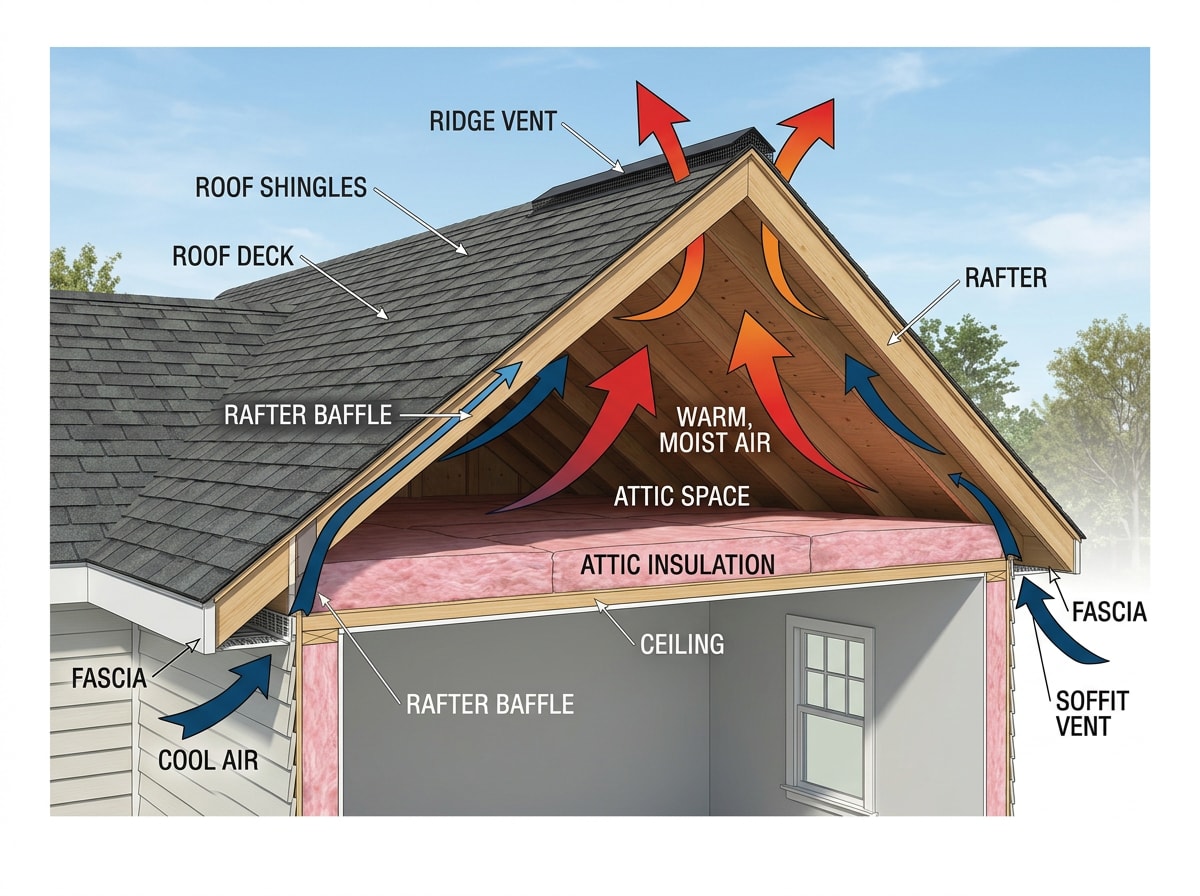
One habit causes more ventilation failures than any product defect. Homeowners (or installers) laying fresh insulation often push it right over the soffit, closing off the intake side of the loop entirely. Blocking airflow at the eaves is the most common mistake made during insulation work, which is why soffit vents should never be covered with insulation.
How Poor Roof Ventilation Raises Energy Costs
Poor ventilation lets heat and humidity build up in the attic, and that trapped heat radiates downward into living spaces. Your HVAC system responds by running longer and more often than it should.
Common warning signs include:
- Upper-floor rooms that stay noticeably hotter than the rest of the house
- Summer energy bills that climb without an obvious cause
- A musty smell lingering in the attic
- Frost, condensation, or staining on the underside of the roof deck in winter
A blocked or undersized system doesn't just cost comfort. In field testing on a Florida test home, sealing attic vents increased annual cooling energy use by 5 to 10 percent, adding an estimated $25 to $54 a year on a 1,620 square foot home with R-30 ceiling insulation. That study was run in a different climate than Northern Virginia, but it shows the real cost of restricted airflow even in an attic with decent insulation already in place. A home with ductwork running through the attic, common in many Reston-area houses built from the 1970s through the 1990s, tends to feel the effect even more directly.
Signs Your Reston Home Needs Better Roof Ventilation
Any one of these symptoms on its own may not mean much. Two or more together usually point to an airflow problem worth checking:
- Shingles that curl, crack, or lose granules earlier than expected
- Ice buildup along the eaves after a snow event
- Rooms under the attic that never quite match the thermostat setting
- Visible mold, mildew, or dark staining on roof sheathing
A roof inspection can confirm whether these symptoms trace back to ventilation, insulation, or both. If your roof is already due for new shingles or decking, a roof replacement is the most efficient time to correct an undersized or unbalanced vent system at the same time.
Types of Roof Ventilation Systems That Save Energy
Roof ventilation falls into two categories: passive systems that rely on pressure and temperature differences, and active systems that use a fan to move air.
| Vent Type | How It Works | Power Needed | Best Use Case |
|---|---|---|---|
| Ridge vent | Continuous exhaust along the roof peak | None | Most sloped residential roofs |
| Soffit vent | Intake along the eaves | None | Paired with any exhaust vent |
| Gable vent | Exhaust at the gable end wall | None | Homes without a continuous ridge |
| Powered attic fan | Electric fan forces air out | Yes | Rarely recommended as a first fix |
| Solar attic fan | Fan runs off a small solar panel | Self-powered | Supplemental exhaust in high-heat attics |
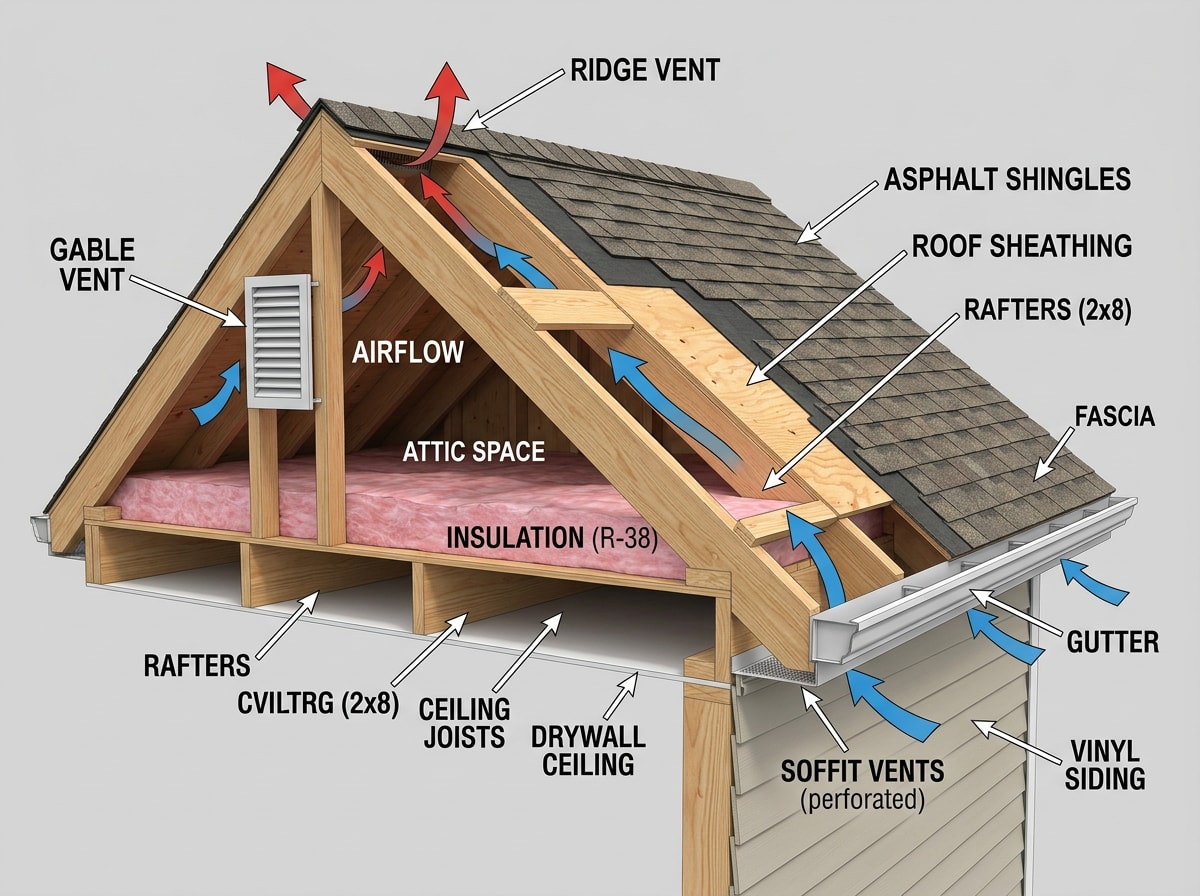
For most sloped roofs in the Reston area, a balanced passive system of ridge and soffit vents performs well with little maintenance. Sizing isn't guesswork. The International Residential Code requires enclosed attic spaces to maintain a minimum net free ventilating area of 1/300 of the attic floor when vents are split between upper and lower openings, or 1/150 when a home lacks eave openings for intake. A roof installation is the natural point to verify these ratios are met, since vent placement is easiest to correct before shingles go back down.
Beyond Energy Bills: Roof Lifespan, Moisture, and Air Quality
Energy savings aren't the only payoff. Balanced ventilation reduces the heat and moisture cycles that degrade shingles, decking, and underlayment over time.
A dry and well-ventilated attic helps avoid moisture problems and lowers both heating and cooling costs.
Improper ventilation, by contrast, allows moisture to build up and can lead to mold, ruined insulation, and wood rot. That moisture risk is also a factor in choosing roofing materials. Reflective or heat-shedding materials reduce how much the ventilation system has to work in the first place; our guide to different types of metal roofing in Reston, VA covers how material choice and ventilation work together on hot roofs.
How to Get Your Roof Ventilation Assessed and Upgraded
A professional ventilation assessment is the most reliable way to know whether your current system is adequate. An inspector checks for blocked vents, undersized intake or exhaust area, and damage limiting airflow that may not show up as an obvious symptom yet.
Climate matters, too. What works in a dry climate can underperform in the humid summers and cold snaps typical of Northern Virginia. Homeowners near Reston, VA should have any ventilation upgrade matched to both their roofing material and local weather patterns, not a one-size-fits-all fix. If your current system is failing because of damaged flashing, cracked boots, or storm damage around vent penetrations, a roof repair can often resolve airflow problems without a full replacement.
In more than a decade of inspecting attics across Northern Virginia, undersized soffit intake, not a lack of ridge vent, is the imbalance we find most often on homes with high summer cooling bills. Fixing the intake side usually solves the problem faster than adding more exhaust ever does.
Request a free estimate to have your attic's intake and exhaust balance checked before summer or winter extremes put more strain on the system.
Smart Ventilation Technology for 2026 and Beyond
Powered attic fans have a mixed reputation for good reason. Many building scientists consider the risks of standard powered attic fans greater than the benefits, and the ENERGY STAR program does not recommend them unless they are solar powered and properly matched to adequate intake. That caution matters because an underpowered intake side turns any fan into an energy liability rather than a savings tool.
Solar attic fans sidestep part of that problem since they don't draw from the home's electric service, and many newer models add a humidistat or thermostat to cycle on only when conditions call for it. Sensor-based attic monitors are the other real shift available now, tracking temperature and humidity and flagging conditions before they show up as a utility bill spike. None of this replaces a correctly sized passive system. It just makes it easier to catch a problem early.
About Style Installations Inc.
This guide was prepared by the roofing team at Style Installations Inc., a Northern Virginia roofing contractor serving Reston and the surrounding region. Questions about a specific attic or roof system can be directed through our contact page, and homeowners can learn more about our full range of services on our homepage.
FAQ
How much can proper roof ventilation save on energy bills?
Savings vary by climate, attic size, and existing insulation, so there's no universal percentage. Field data shows sealed or blocked vents can increase cooling costs by 5 to 10 percent on an otherwise insulated home, which gives a rough sense of what correcting the imbalance can recover.
Can you have too much roof ventilation?
Yes. Exhaust without matching intake disrupts the airflow loop and can pull conditioned air from the house instead of venting the attic. The goal is matched net free vent area on both the intake and exhaust side, not simply adding more vents.
How often should roof ventilation be checked or inspected?
An annual inspection, plus a check after major storms, is a reasonable schedule. Look for vent blockages from debris, nesting animals, or insulation that has shifted over the soffit.
What's the difference between passive and active roof ventilation?
Passive ventilation uses natural airflow with no moving parts or power source. Active ventilation uses a powered or solar fan to force air movement. Passive systems need less maintenance; active systems can move more air in demanding conditions, but only when intake is already sufficient.
Does attic insulation matter as much as ventilation?
Yes, and they work together, not separately. Insulation controls heat transfer through the ceiling; ventilation controls temperature and moisture above it. Neither one fixes a problem caused by the other.
Does Reston's climate change how much ventilation a home needs?
Reston sees hot, humid summers and cold winters with occasional ice events, so a system has to handle both heat exhaust and moisture control from condensation. A ventilation plan built for a drier or milder climate often underperforms here.